When I stop to think about it, 2026 has really been transformative.
What seemed impossible a year ago is actually happening: we barely write code anymore.
It is easy to talk about the good parts: the huge productivity gains and the speed. But I keep finding myself thinking about the less obvious parts — the parts I don't see brought up that much.
The scheduling problem
In the old world, whenever you had a coding task, you usually had the privilege of sitting down and thinking about it deeply, because you were the one who had to write the code by hand.
For our brains, that was great. We work best when we can focus deeply on a single task, entering that zone where everything else disappears.
I was always fascinated by that almost meditative state, where I could feel like I was one with the code and actually getting something meaningful done.
In the new world, though, reaching that zone has become almost impossible.
Given the ability to parallelize work that agents have brought us, the constant productivity advice I see thrown around is basically:
just run 50 Claudes bro
But we know multitasking is a myth. So why are we suddenly glorifying it?
Coding agents can scale our ability to produce code immensely, but running 20 of them puts pressure on what is now our most valuable resource: high-context judgement.
Juggling multiple tasks across multiple contexts is exhausting. It gives you a false sense of throughput, while in practice you may be making worse decisions every time you steer one of your agents.
Work becomes more fragmented and shallower.
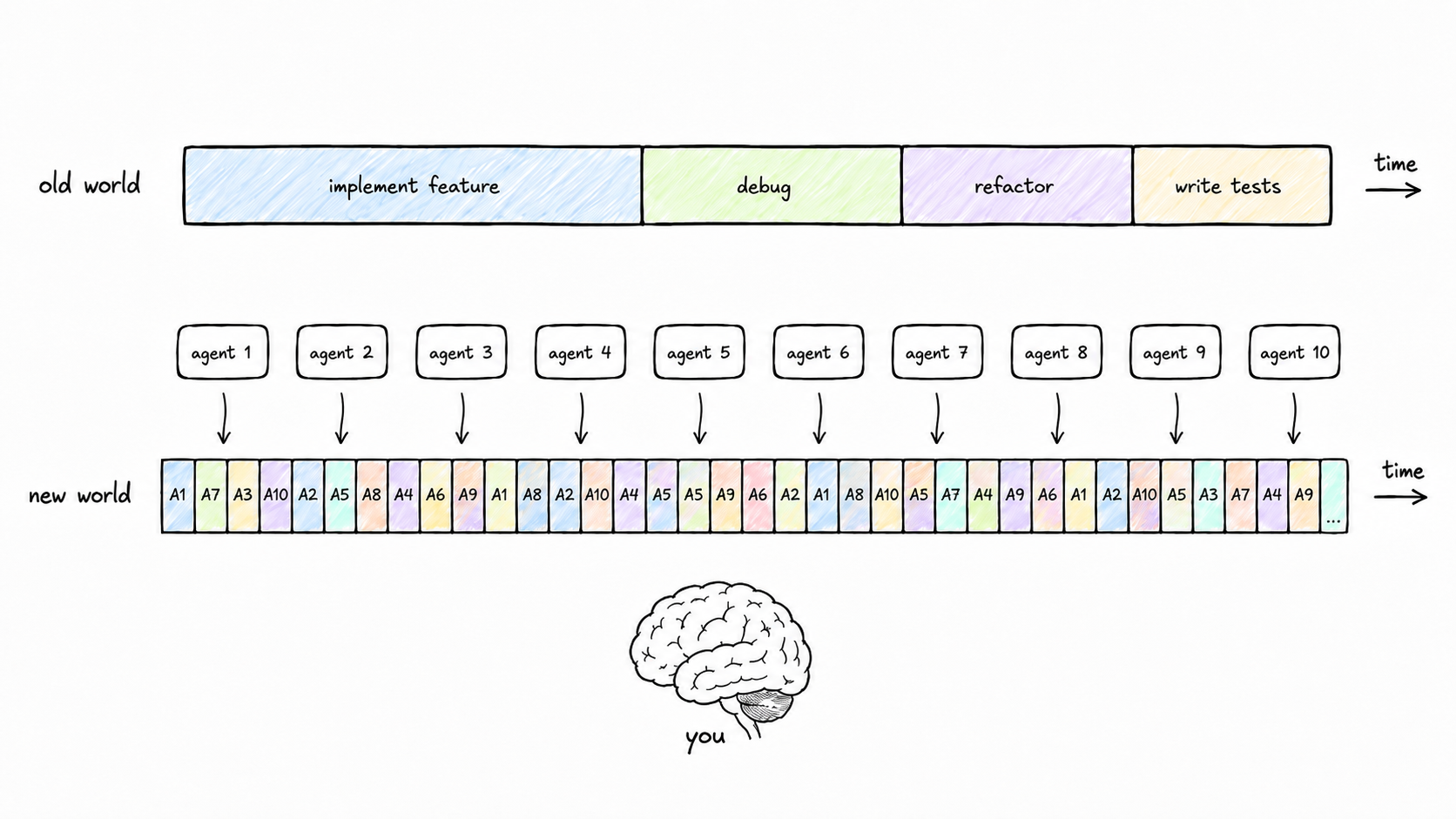
So what should we do?
Bezos used to say that if he made a few good decisions per day, that was enough. I am starting to feel like that is closer to how we should treat ourselves in this new world.
Coding agents can deliver code at an unprecedented pace, but they still cannot ensure that what they are building is solving the right problem.
My take is that we have to protect our judgement, even if that means being a bit more idle than we are used to.
After all, wasn't working less supposed to be part of the promise of AI?
Recently, I have been trying to read while a couple of agents work, instead of spawning more and more threads of work until I eventually end up exhausted.
Because while I could start more agents, effective outcomes still have many of the same bottlenecks we had before.
For example, we are still bad at coming up with requirements upfront without iterating, testing, and having humans actually use our product to drive its development. Agents don't solve that.
That does not mean we should avoid using AI to build and grow products. But once again, we should protect our now scarce resource which is taste: the high-context judgement required to give a product integrity.
Final thoughts
Coding agents are here to stay, and they probably should be.
We will have to learn and adapt to this new world, where you just can't get the same excitement from writing code as before.
In many ways, it does feel like the industrial revolution. I would not be surprised if we start seeing GitHub repos advertised as "hand-crafted code", just like manufactured goods.
But part of me still feels sad.
I mourn the loss of something I deeply cared about.